
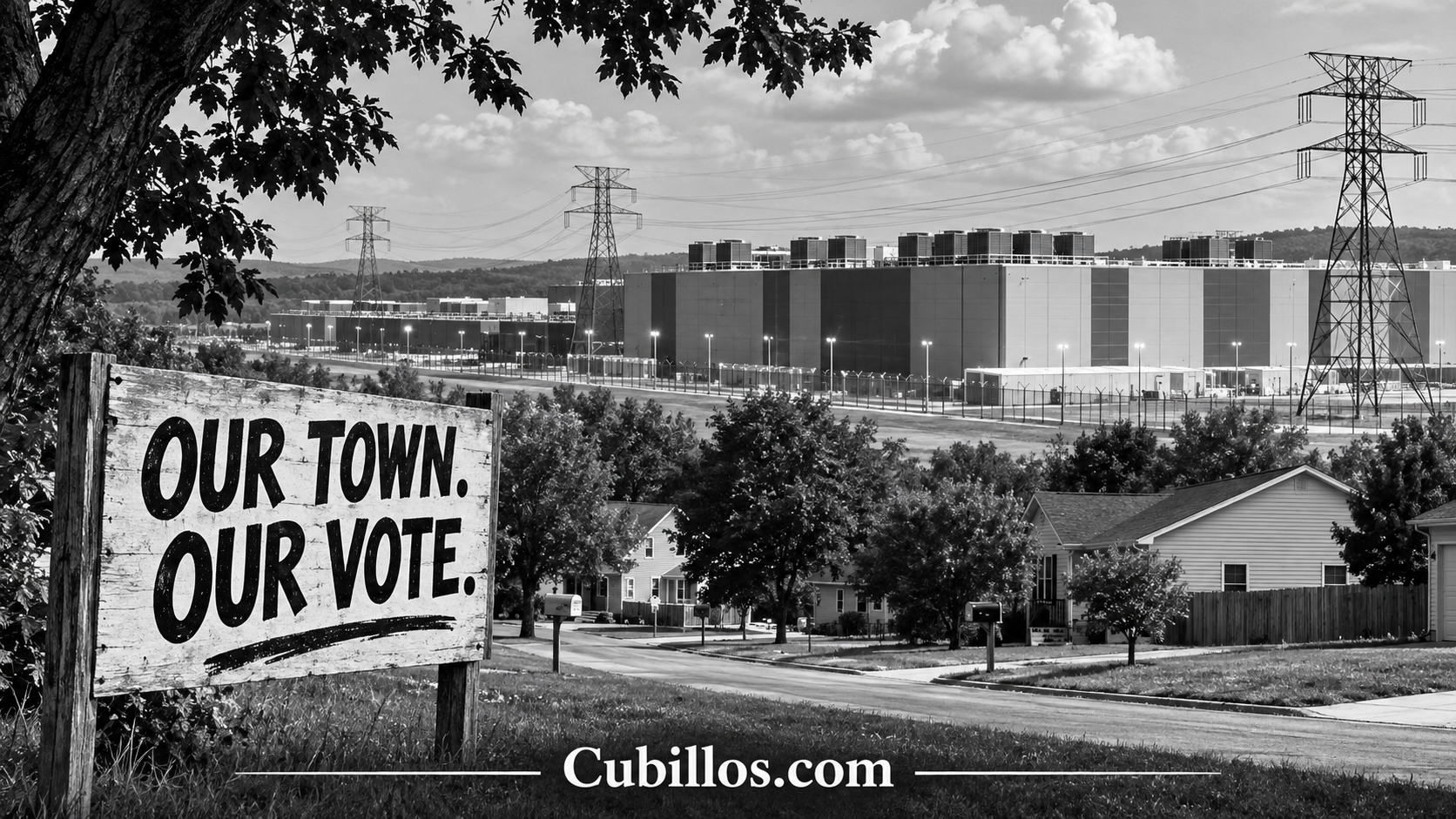
Here’s something that ought to make the political consultants scratch their heads.
Opposition to data centers isn’t confined to Democrats, Republicans, liberals, conservatives or independents.
It’s showing up in communities across the political spectrum.
In an era when Americans seem capable of turning a disagreement over the weather into a partisan brawl, they’ve discovered something they can agree on.
They don’t particularly care for the idea of wealthy corporations showing up, demanding enormous amounts of electricity and water, collecting generous tax incentives and leaving the neighbors wondering who’s going to pay for it all.
A conservative worried about government subsidies can find common ground with a progressive worried about environmental damage.
A Republican farmer concerned about groundwater can agree with a Democratic homeowner concerned about electricity rates.
And an independent small-business owner might reasonably wonder why a corporation worth hundreds of billions of dollars needs a tax break when the local hardware store doesn’t get one.
Now there’s a political coalition nobody saw coming.
To be clear, these local election results don’t establish how members of each political party voted. But the opposition stretches across communities with very different political traditions, from California and Illinois to Kansas, Ohio and Florida.
The concerns also cut across traditional ideological lines.
Some voters want environmental protections. Others want fiscal accountability. Still others want local control over development decisions.
And some simply want the politicians to stop treating their communities like vacant lots waiting for a corporate tenant.
For once, the argument isn’t necessarily about red states and blue states.
It’s about electric bills, water supplies, property taxes and whether the people who live in a community get to decide what happens to it.
Turns out those questions don’t come with party registration cards.
And perhaps that’s what makes this election particularly interesting.
The technology companies have spent billions teaching computers to recognize patterns. They might want to study the one American voters just handed them.
The folks building America’s artificial intelligence empire have discovered that the American people are not nearly as enthusiastic about enormous computer warehouses as the people financing them.
And judging by Tuesday’s election results, the public has a few questions.
Questions about electricity. Questions about water. Questions about taxes. Questions about who gets rich and who gets stuck with the bill.
Imagine that.
For years, we’ve been told artificial intelligence is the next great technological revolution. It’s going to transform medicine, education, manufacturing, transportation and just about everything else short of teaching your dog to fetch the newspaper.
I happen to believe much of that promise.
But somewhere between the sales pitch and the construction permits, somebody forgot to ask the neighbors.
On Nov. 3, those neighbors answered anyway.
According to a nationwide election analysis published Wednesday, voters considered 41 local ballot measures involving data centers in 10 states.
Of the 38 measures with reported outcomes, 37 went against unrestricted data center development. Only one favored the developers.
Three results remained unreported.
That’s not a political landslide. That’s the electorate taking a two-by-four to the industry’s business plan.
And the voters weren’t finished.
Six earlier ballot measures in 2026 had already produced outcomes opposing data center development. Three more measures are scheduled for December.
All told, at least 50 measures in 13 states have made data centers a local election issue this year.
The industry might want to consider putting somebody from the public relations department on overtime.
Here’s where the whole business gets interesting.
Data centers aren’t some newfangled invention. We’ve had them for decades. Banks use them. Hospitals use them. Newspapers use them. So does practically every business with a computer.
What’s changed is the scale.
The newest artificial intelligence facilities can consume hundreds of megawatts of electricity. Some proposed campuses would require considerably more.
That’s enough power to make a utility company start looking at its generating capacity, transmission lines and long-term construction plans.
And when somebody has to build new power plants, substations or transmission infrastructure, the obvious question becomes: Who pays?
The technology companies will tell you they intend to cover their costs.
That’s a fine intention.
But intentions don’t pay electric bills.
Utility rates depend on regulatory decisions, financing arrangements, contracts and how infrastructure costs are allocated. A company may pay for its direct connection while other expenses find their way into the broader electric system.
That doesn’t mean every data center raises residential electricity rates.
It means somebody ought to demonstrate that it won’t.
Before construction begins.
Not after the neighbors open their monthly electric bills and discover they’re helping finance somebody else’s artificial intelligence revolution.
Then there’s water.
Some data centers use evaporative cooling systems that consume substantial amounts of water. Others rely on different cooling technologies that can sharply reduce water consumption, sometimes at the expense of greater electricity demand.
The amount depends on the facility, its equipment, its location and the cooling system selected.
Those distinctions matter.
A data center in a water-rich region isn’t necessarily the same proposition as one built where farmers, homeowners and municipalities are already competing for limited supplies.
But developers have a habit of discussing these details after they’ve announced the investment, the jobs and the projected economic benefits.
Funny how that works.
If a company wants millions of gallons of water, the community deserves to know how much, where it will come from and what happens during a drought.
That’s not anti-technology.
That’s arithmetic.
And now we come to my favorite part.
Tax incentives.
Nothing warms the heart of an American politician quite like the prospect of standing beside a corporate executive announcing a multibillion-dollar investment.
There will be photographs.
There will be speeches.
There will be promises about economic development, construction jobs and the bright technological future awaiting the community.
There may even be a ceremonial shovel.
What there frequently won’t be is a detailed public discussion about the difference between temporary construction employment and permanent jobs after the facility opens.
A giant data center can cost billions of dollars to construct without employing anything resembling the workforce of a comparably expensive manufacturing operation.
That doesn’t mean the investment has no value.
It means the public ought to know what it’s buying.
How many permanent jobs?
What salaries?
What property taxes will actually be collected after exemptions and abatements?
How much new infrastructure will the municipality need?
And how many years before the promised benefits exceed the public costs?
These are questions that ought to be answered before the politicians start congratulating themselves.
If the technology industry wants to understand what happened Tuesday, it might begin with Ohio.
Voters there considered 21 data center-related ballot measures.
In Ashville, approximately 82 percent voted against a development agreement involving EdgeConneX.
In Granville, roughly 82 percent supported a data center ban.
In Pataskala, about 74 percent approved restrictions on large-scale facilities.
In Wilmington, voters rejected four separate rezoning proposals associated with potential data center development.
And in Perry, voters approved financial safeguards requiring developers seeking tax incentives to back up their economic promises.
Now there’s an interesting concept.
Make the people promising the moon put some money behind the promise.
One suspects that idea could catch on.
Ohio wasn’t alone.
Voters in Kansas approved restrictions in El Dorado, Emporia and Ottawa.
In Maine, communities approved bans or temporary moratoriums.
In Alhambra, California, voters supported prohibiting data centers.
And in Edgewater, Florida, approximately 77 percent voted to prohibit new facilities and expansions.
The opposition wasn’t confined to traditionally liberal communities.
Nor was it limited to conservative ones.
Which ought to tell the political consultants something.
American politics has become so tribal that we sometimes forget people can agree on something without first checking which political party supports it.
A conservative homeowner worried about rising electric bills has something in common with a liberal environmentalist worried about water consumption.
A farmer concerned about groundwater has something in common with a suburban resident who doesn’t want a massive industrial complex next door.
And a small-business owner who pays full property taxes might reasonably wonder why a corporation worth hundreds of billions of dollars needs a tax break.
These people may disagree about practically everything else.
But they can all recognize a bad deal.
The election results don’t tell us precisely how Republicans, Democrats and independents voted on each measure. Most of these were local contests without partisan breakdowns.
Still, the geographic spread suggests the opposition cannot be explained away as a single party’s campaign.
The industry would be making a serious mistake if it tried.
Some voters went after the politicians
The backlash didn’t stop with zoning ordinances.
Data center disputes also figured in local recall elections.
In Piqua, Ohio, three city commissioners were recalled.
In Urbana, Ohio, Mayor Bill Bean was recalled.
In Mason, Michigan, a city council member was recalled.
These were local political fights with their own circumstances, and it would be foolish to attribute every vote solely to data centers.
But the pattern deserves attention.
People weren’t simply expressing frustration with proposed developments.
In some communities, they were holding elected officials accountable for decisions already made.
That’s democracy functioning exactly as advertised.
The public hires the politicians.
The public can fire them.
Before anybody declares victory
Now, a word of caution.
Not all 37 election outcomes amounted to bans.
Some were temporary moratoriums.
Some established additional zoning requirements.
Others required voter approval for certain developments.
Several were nonbinding advisory questions that expressed public opposition without changing the law.
And some involved specific projects rather than all data centers.
Those distinctions matter.
A six-month moratorium isn’t a permanent prohibition. An advisory vote isn’t a zoning ordinance. And rejecting a particular development agreement doesn’t necessarily prevent another company from proposing a different project.
There are also legal questions about existing permits, grandfathered developments and whether particular restrictions will survive court challenges.
The election results demonstrate substantial public resistance.
They do not establish that 37 data center projects have been permanently canceled.
That would be a different story.
And an important one.
We still need the technology
Here’s where I part company with those who believe the answer is simply to stop building data centers.
It isn’t.
Artificial intelligence and advanced computing are becoming essential to medicine, scientific research, transportation, manufacturing and national security.
The military increasingly depends on enormous computing resources for intelligence analysis, logistics, simulation, autonomous systems and other operations.
America cannot afford to abandon advanced computing infrastructure.
Nor should it.
But technological progress doesn’t give corporations a blank check to consume public resources without public scrutiny.
We built the interstate highway system because the country needed it.
We built the electrical grid because modern society required it.
We built airports, ports, telecommunications networks and industrial facilities because they served economic and national interests.
And along the way, Americans fought bitterly over where those projects would go, who would pay for them and what communities would lose.
Sometimes the public was right.
Sometimes the developers were right.
And sometimes everybody was wrong.
The lesson isn’t that progress should stop.
It’s that progress has consequences.
The people who live there get a vote
The technology industry has spent billions convincing investors that artificial intelligence represents the future.
Investors apparently believe it.
The stock market certainly has.
And governments, eager to attract investment, have often rolled out the welcome mat.
But the people living near proposed facilities have their own ideas about the future.
They want reliable electricity.
They want affordable water.
They want decent roads, functioning schools and property taxes that don’t punish ordinary homeowners while rewarding wealthy corporations.
They want to know what happens when a project doesn’t deliver what was promised.
And, most of all, they want somebody to ask before making decisions that could change their communities for decades.
That’s not an unreasonable demand.
It’s the foundation of local government.
The companies building artificial intelligence systems pride themselves on developing machines capable of answering increasingly complicated questions.
Perhaps they ought to turn one of those machines toward a simpler problem.
How do you convince a community that your multibillion-dollar project will make life better for the people who already live there?
Here’s a suggestion.
Start by telling them the truth about the costs.
Then show them the benefits.
And for heaven’s sake, listen when they answer.
Because on November 3, the voters did answer.
And judging by the results, quite a few technology executives probably wish they’d asked the question sooner.
2026 DATA CENTER BALLOT MEASURES
Nationwide election results and status
Updated November 4, 2026
The following inventory covers 50 local ballot measures identified by Ballotpedia across 13 states. Forty-one appeared on November 3 ballots, six were decided earlier in 2026 and three are scheduled for December.
November 3 results: 37 outcomes favoring restrictions, one favoring development and three not yet reported.
Important: Results are preliminary and may change before certification. Measures range from outright bans to nonbinding advisory votes. An outcome opposing development does not necessarily mean a facility has been prohibited.
OHIO — 21 measures
| Community | Measure | Status |
|---|---|---|
| Ashville | EdgeConneX development agreement | Rejected — 82% opposed |
| Conneaut | Ban facilities exceeding 25 MW | Approved — 65% |
| Defiance | Ban facilities exceeding 25 MW | Approved — 65% |
| Granville | Data center ban | Approved — 82% |
| Grove City | Voter approval for major developments | Approved — 55% |
| Hubbard | Data center ban | Approved — 77% |
| Monroe Township | Township zoning | Result pending |
| Monroeville | Advisory support for data centers | Rejected — 87% opposed |
| Oregon | Ban facilities exceeding 25 MW | Approved — 60% |
| Pataskala | Large-scale data center ban | Approved — 74% |
| Perry | Financial guarantees for tax incentives | Approved — 87% |
| Piqua | Data center ban | Approved — 67% |
| Sprigg Township | Township zoning | Result pending |
| Sunbury | Ban facilities exceeding 25 MW | Approved — 79% |
| Trenton | Large-scale data center ban | Approved — 80% |
| Upper Sandusky | Data center ban | Approved — 77% |
| Urbana | Data center ban | Approved — 77% |
| Wilmington | Rezoning: 1957 SR 730 | Rejected — 80% opposed |
| Wilmington | Rezoning: McGuinn Road | Rejected — 80% opposed |
| Wilmington | Rezoning: SR 730 | Rejected — 80% opposed |
| Wilmington | Rezoning: US 68 South | Rejected — 80% opposed |
ILLINOIS — 7 measures
All seven were advisory questions.
| Community | Measure | Status |
|---|---|---|
| Bloomington | Support data center moratorium | Approved — 78% |
| Chouteau Township | Support data center development | Rejected — 83% opposed |
| Granite City Township | Support data center development | Rejected — 74% opposed |
| Joliet | Support AI data centers | Rejected — 79% opposed |
| Morgan County | Support development restrictions | Approved — 88% |
| Nameoki Township | Support data center development | Rejected — 78% opposed |
| Venice Township | Support data center development | Rejected — 76% opposed |
KANSAS — 3 measures
| Community | Measure | Status |
|---|---|---|
| El Dorado | Ban high-impact data centers and certain battery facilities | Approved — 71% |
| Emporia | Ban high-impact data centers | Approved — 60% |
| Ottawa | Ban facilities exceeding 25 MW | Approved — 69% |
MAINE — 4 measures
| Community | Measure | Status |
|---|---|---|
| North Berwick | Ban facilities of 25,000 square feet or more | Approved — 78% |
| Peru | 180-day moratorium | Approved — 76% |
| Wells | 180-day moratorium | Approved — 82% |
| Wiscasset | Six-month moratorium | Approved — 66% |
CALIFORNIA — 1 November measure
| Community | Measure | Status |
|---|---|---|
| Alhambra | Measure DB: Data center prohibition | Approved — approximately 82% |
FLORIDA — 1 measure
| Community | Measure | Status |
|---|---|---|
| Edgewater | Charter amendment prohibiting new data centers and expansions | Approved — approximately 77% |
NEVADA — 1 measure
| Community | Measure | Status |
|---|---|---|
| Boulder City | Permit data centers in Eldorado Valley Transfer Area | Result pending |
NEW JERSEY — 1 measure
| Community | Measure | Status |
|---|---|---|
| Downe Township | Advisory support for data centers | Rejected — 87% opposed |
NORTH DAKOTA — 1 November measure
| Community | Measure | Status |
|---|---|---|
| Harwood | Additional industrial development reviews | Rejected — 75% opposed; outcome favors development |
WISCONSIN — 1 November measure
| Community | Measure | Status |
|---|---|---|
| Janesville | Voter approval for major development at former GM/JATCO site | Approved — 63% |
EARLIER 2026 ELECTIONS — 6 measures
| State | Community | Date | Status |
|---|---|---|---|
| New Hampshire | Canterbury | March 10 | Data center ban approved — 84% |
| Wisconsin | Port Washington | April 7 | Voter approval requirement approved — 66% |
| California | Monterey Park | June 2 | Data center ban approved — 88% |
| Michigan | Augusta Township | August 4 | Data center rezoning rejected — 90% opposed |
| Wisconsin | Wrightstown | August 8 | Advisory support rejected — 87% opposed |
| New Hampshire | Nottingham | September 8 | 12-month moratorium approved — 90% |
UPCOMING ELECTIONS — 3 measures
| State | Community | Election | Measure |
|---|---|---|---|
| Arkansas | Clarksville | Dec. 1 | Up to $50 billion in industrial development bonds for Hatchbo |
| Arkansas | Clarksville | Dec. 1 | Up to $5 billion in industrial development bonds for SF ARK1 |
| North Dakota | Mandan | Dec. 15 | Prohibit facilities requiring 25 MW or more |
The Arkansas amounts are proposed bond authorization limits, not expenditures already incurred.
Sources and methodology
Ballotpedia: Data Center-Related Ballot Measures, 2026. Nationwide inventory of 50 measures in 13 states.
Duane Morris Government Strategies: Data Centers on the Ballot: Where Things Stand. November 4, 2026. Nationwide results tracker, updated as election returns became available.
Redbud Consulting: Data Centers on the Ballot — 2026 Results. Election tracking and local returns.
Venable LLP: Voters Approve Data Center Restrictions at the Ballot Box. November 4, 2026. Legal analysis of selected measures.
Editor’s note: Vote percentages are rounded and reflect reported unofficial returns. Some jurisdictions may continue counting ballots. Election officials must certify final results. The inventory counts individual ballot questions, including multiple questions within the same municipality; it does not represent 50 separate communities or 50 canceled projects.