
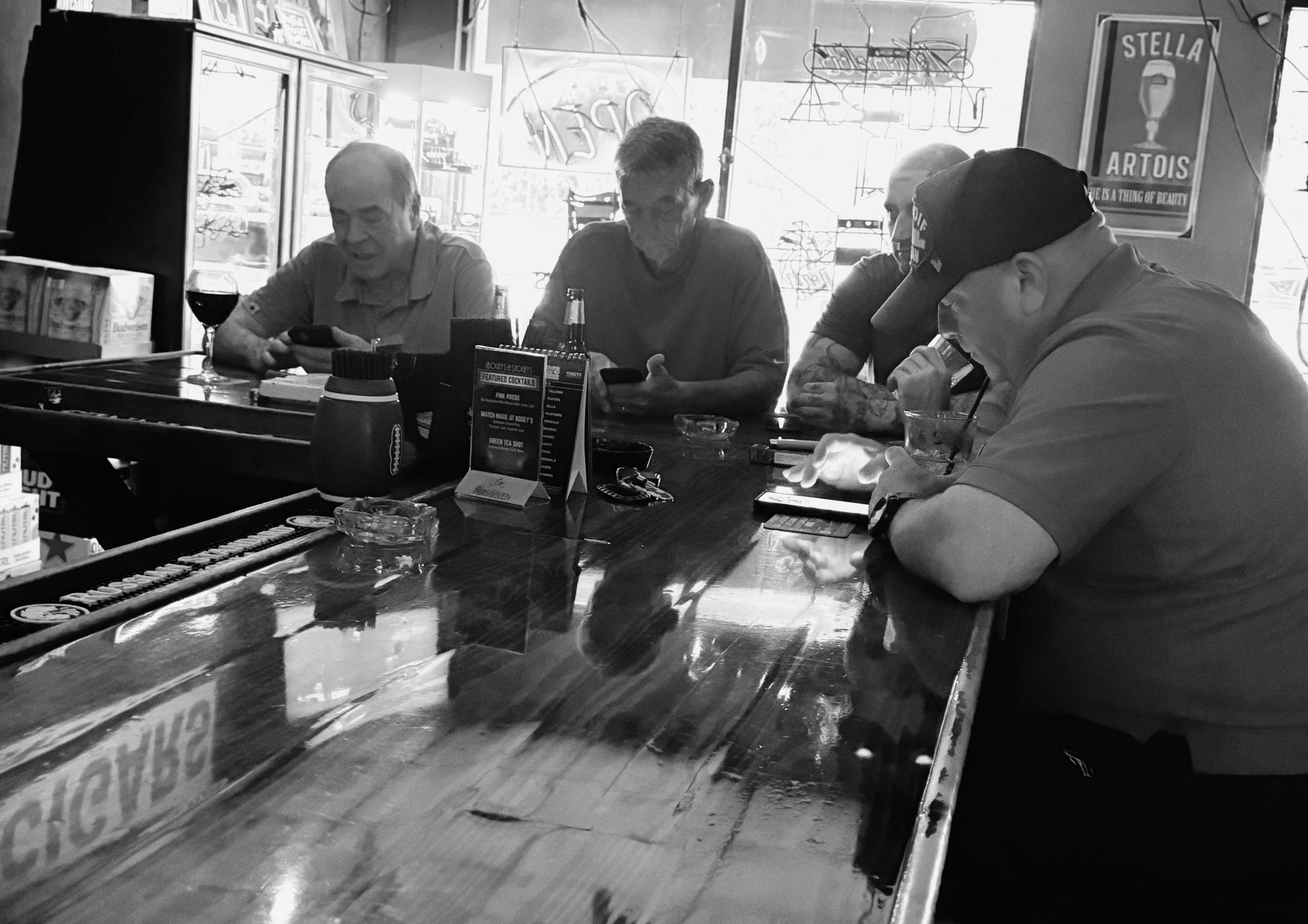
The light comes through one window at Bogeys and Stogeys, and that’s where I sit.
I don’t smoke.
This is not necessarily an advantage at Bogeys.
Cigarettes. Cigars. Smoke hanging in the darker reaches of the room and wandering through the shaft of Florida daylight coming through the window. Bogeys is a smoking dive bar, unapologetically so, and I’ve been coming here for the better part of 20 years.
My place is near the window.
The light.
Bogeys has what is reputed to be the longest bar in town, a great run of wood lined with wooden stools with backs, stretching away from my window into the darker end of the place.
During the day, those stools belong mostly to the day-drinkers.
Regulars. Retirees.
Some of these people appear to have been sitting there since God created the earth. If archaeologists ever excavate Bogeys, I fully expect several of the stools to be carbon-dated along with the occupants.
A stool opens beside me.
I spot a friend farther down the bar.
I wave.
“Come to the light.”
He comes.
In front of me is a Long Island Iced Tea.
From that stool in the light, I can see almost the whole joint.
And after 20 years of sitting there, I’ve finally realized something.
Bogeys and Stogeys is a Silicon Valley node.
With beer.
The door opens.
Two young women walk in.
Each has a phone in her hand.
Not buried in a purse.
Not tucked into a pocket.
In their hands.
They haven’t found a stool yet. Haven’t ordered a drink. But the phones came through the door with them, already out, already part of whatever happens next.
Twenty years ago, you noticed the person who had a smartphone.
Today, you notice the person who doesn’t.
A little farther down the bar sits a working student.
A shock of pink hair.
Her laptop is open on the bar.
Homework on the screen.
A beer beside it.
A cigarette dangling from her lips.
She types.
Takes a drag.
Types.
Takes a drink.
Types some more.
The old world and the new world aren’t fighting each other.
They’re sharing a barstool.
Another customer comes in and heads for the humidor.
Cigars.
There may be nothing in Bogeys less digital than a cigar.
He makes his selection and gives it to the bartender to package.
He sits briefly.
Out comes the phone.
Look.
Tap.
Tap.
The cigars are ready.
He gets up.
Pays by card.
And leaves.
Cigar from a humidor.
Smartphone in the hand.
Plastic card talking to a bank.
Nobody notices the technology because nobody thinks of it as technology anymore.
That’s just life.
My father once owned a bar.
This was back in the mid-1960s.
The Copa Cabana.
It was not a timid establishment.
There was a pool room off to the side.
And two large bird cages.
Inside them, dancers in glittery bikinis with tassels.
Apparently nobody in the mid-1960s had yet invented the concept of understatement.
And there was a jukebox.
A real jukebox.
The old kind.
It took coins.
You wanted music, you put in a coin and made your selection.
Simple.
Today at Bogeys, I want Motown.
I don’t get off my stool.
Why exhaust myself?
I pull out my phone.
Open TouchTunes.
Buy credits.
Scroll.
The Temptations.
The Four Tops.
Marvin Gaye.
Smokey Robinson.
Tap.
A few seconds later, Motown rolls through a smoky dive bar.
And out of the speakers comes Detroit.
My father’s jukebox needed a coin.
Mine needs a data center.
We didn’t change the desire very much.
We just built one hell of a lot of machinery between the finger and the song.
Twenty years ago, Bogeys wasn’t like this.
Neither were we.
My friend, Paul, held out longer than most.
Paul had a flip phone.
It was a telephone.
You called Paul.
It rang.
Paul answered.
This seemed perfectly satisfactory to Paul, who had somehow acquired the quaint notion that making telephone calls was an appropriate function for something called a telephone.
Eventually civilization came for him.
Paul finally surrendered and bought a smartphone.
He brought it into Bogeys.
Tracy, one of the bartenders, had to set it up for him.
The great digital revolution arrived in Paul’s life at a smoking dive bar.
Technical support was behind the bar.
Now look down that same bar.
Phones everywhere.
On the bar.
In hands.
Beside drinks.
People scrolling, tapping, texting, checking scores, looking at photographs, watching videos.
And then there’s the almost-deaf Texan.
He holds up his phone.
“HEY, SIRI!”
The whole bar can hear him.
Siri, apparently, has no choice.
“HEY, SIRI!”
Somewhere, computers in a data center hear him just fine.
And the phones need feeding.
There are power outlets under the bar.
The bartenders keep charging cords.
Somebody inevitably arrives without one.
The battery drops.
Eleven percent.
Ten.
Nine.
Concern sets in.
A charging cord appears from behind the bar.
Civilization saved.
Might as well have another drink.
But there’s a little business lesson underneath that bar, too.
Keep the phone charged.
Keep the customer comfortable.
Keep the customer sitting on the stool.
Sell another beer.
Or, in my case, another Long Island Iced Tea.
There’s your MBA.
The electrical outlet isn’t there because the bar owner decided to participate in the digital revolution.
It’s there because getting a customer to stay a little longer has been good bar business since long before anybody had heard of Wi-Fi.
The technology changed.
The business model didn’t.
A comfortable customer stays.
A customer who stays buys another drink.
Bogeys didn’t become digital because somebody wanted Bogeys to become digital.
Bogeys became digital because customers did.
Televisions glow around Bogeys.
One has a live game.
Another has a newer station showing videos.
Another may have the weather.
The signal comes by satellite.
Nobody thinks about the satellite.
Then weather happens.
Thunder.
Lightning.
Rain.
The picture freezes.
Pixelates.
Gone.
If it’s a commercial, nobody cares.
If it’s the fourth quarter, the bar suddenly contains more satellite experts than NASA.
The storm passes.
The picture returns.
Nobody thinks about the satellite again.
That’s how infrastructure works.
We notice it mainly when it doesn’t.
Over there is the golf machine.
Connected.
The bowling machine.
Connected.
The jukebox.
Connected.
Free Wi-Fi.
Connected.
The credit-card terminal.
Connected.
The ATM.
Connected.
Even the cash machine is connected.
Think about that one.
If you want to escape the electronic economy and pay cash, you walk over to an electronic machine, insert a card, enter a secret number, let computers somewhere talk to your bank, and wait for the machine to spit out twenties.
There.
You have successfully defeated the digital economy.
Take that, Silicon Valley.
Above us are security cameras.
The owner doesn’t have to be sitting at Bogeys to see Bogeys.
A phone or computer somewhere else can bring the bar to the owner.
The bar receives data.
The bar sends data.
So do the people in it.
Good Lord.
Bogeys and Stogeys really is a Silicon Valley node.
With beer.
And lately we’re hearing a lot about data centers.
More precisely, we’re hearing:
No data centers.
We don’t want them.
Too much electricity.
Too much water.
Too much land.
Too many transmission lines.
Some of those objections are legitimate.
A data center doesn’t deserve a free pass because somebody attaches the letters AI to it.
Where the electricity comes from matters.
Water matters.
Cooling matters.
Who pays for new infrastructure matters.
Whether everybody else’s electric bill goes up matters.
Where these enormous buildings are placed matters.
Those are legitimate arguments.
But “build them responsibly” is one argument.
“We don’t need them” is something else.
For that crowd, I have an invitation.
Come to Bogeys.
Come to the light.
Bring your smartphone.
You probably will.
We’ll sit by the window.
Connect to the Wi-Fi.
If your battery gets low, we’ll borrow a charging cord.
We can watch the game.
I’ll pull out my phone and put some Marvin Gaye on TouchTunes.
You can check Facebook.
Read your email.
Check your bank account.
Look at the weather.
Send a photograph.
Watch a video.
If you need cash, use the ATM.
Otherwise, pay with a card.
While we’re doing all that, the golf machine will be connected.
The bowling machine will be connected.
The jukebox will be connected.
The security cameras will be connected.
Our phones will be connected.
The student’s laptop will be connected.
Then, surrounded by all that technology, tell me again we don’t need data centers.
Because every connection has another end.
Somewhere there is a computer answering.
Usually a whole lot of them.
We see the conveniences.
We don’t see the infrastructure.
We want the smartphone but not the server.
The app but not the data center.
The electricity but not the generating plant.
The transmission but not the transmission line.
We want the cloud, apparently under the impression that it is actually located in a cloud.
It isn’t.
The cloud is a building.
A very large building.
Full of computers.
And those computers have to exist somewhere.
That doesn’t mean every proposed data center should be built.
It means we should be honest about why they’re being built.
The demand isn’t coming from the building.
It’s coming from us.
Every tap.
Every swipe.
Every stream.
Every photograph.
Every card transaction.
Every security-camera feed.
Every song.
Every request for Marvin Gaye.
Us.
The data center isn’t the beginning of the chain.
We’re the beginning of the chain.
There is an old American contradiction in all this.
We like steak.
We don’t particularly want to meet the cow.
We like everything the digital world gives us.
We just don’t particularly want to see the machinery that makes the digital world possible.
Put the data center somewhere else.
Put the power plant somewhere else.
Put the transmission lines somewhere else.
Find the water somewhere else.
Just don’t touch the phone in our hand.
And for God’s sake, don’t let the game buffer.
My father’s jukebox was at least honest about the arrangement.
Coin.
Machine.
Music.
You could see the whole damn thing.
Today I touch a piece of glass and Marvin Gaye starts singing.
The machinery has disappeared from view.
And maybe that’s why it’s so easy to pretend we don’t need it.
Until it stops working.
The digital revolution didn’t arrive at Bogeys with robots marching through the front door.
Nobody announced it.
Nobody planned it.
We simply kept saying yes to conveniences.
Wi-Fi?
Yes.
Credit cards?
Yes.
TouchTunes?
Yes.
Security cameras on the phone?
Yes.
Streaming television?
Yes.
Charging outlets?
Yes.
Another app?
Sure.
One convenience at a time.
One connection at a time.
Until two young women walk through the door carrying computers in their hands and nobody notices.
A working student sits at the bar with a laptop, a beer and a cigarette and does her homework.
A man buys cigars, checks his phone while they’re being packaged, pays electronically and leaves.
Paul’s flip phone has become an artifact.
My father’s coin-operated jukebox has become an app.
And somewhere along the way a dark, smoky neighborhood dive bar became part of a global computer network.
Nobody ordered the digital revolution.
We ordered conveniences.
The digital revolution came with them.
And now we’re surprised somebody has to build the machinery to provide them.
We ordered the data centers.
We just didn’t realize they came with the phone.
I look down the long bar.
Smoke hangs in the darkness.
Televisions glow.
Phones glow.
The student’s laptop glows.
Motown is playing.
My Long Island Iced Tea remains reassuringly analog.
I pick it up.
Take a drink.
A stool opens beside me.
I see a friend down toward the dark end of the bar.
I wave.
“Come to the light.”
He does.
Eventually, we all did.