
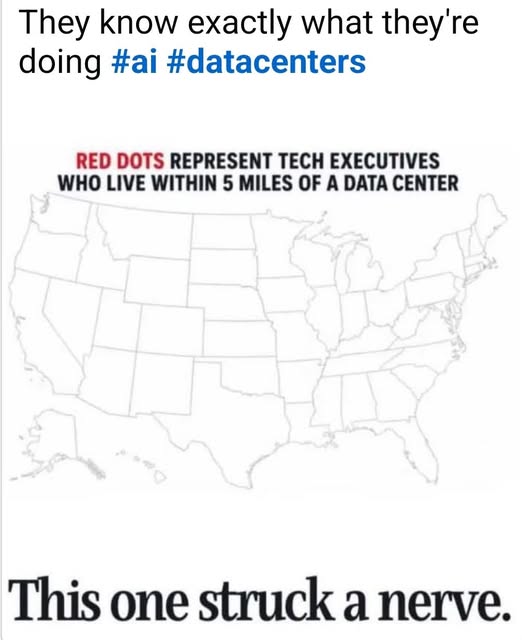
A viral map says no tech executives live within five miles of a data center. So I went looking. Mark Zuckerberg’s neighborhood was about a mile from one. Larry Page’s was, too.
This graphic circulating on social media offers no source, methodology or underlying data. I checked it.
There is a map making the rounds on social media that purports to make a devastating point about America’s data-center boom.
It shows the United States, completely blank.
Across the top are the words:
“RED DOTS REPRESENT TECH EXECUTIVES WHO LIVE WITHIN 5 MILES OF A DATA CENTER.”
There are no red dots.
The message accompanying one version is even less subtle: “They know exactly what they’re doing.”
“It struck a nerve”
It also appears to be nonsense.
The graphic provides no source. No database. No names of executives. No addresses of data centers. No explanation of what qualifies someone as a “tech executive.” No methodology for calculating five miles.
Nothing.
Just a blank map and an accusation.
So I decided to put some dots on the map.
The reality in Silicon Valley: operating data centers sit among the communities where some of America’s best-known technology executives live. Click for larger view.
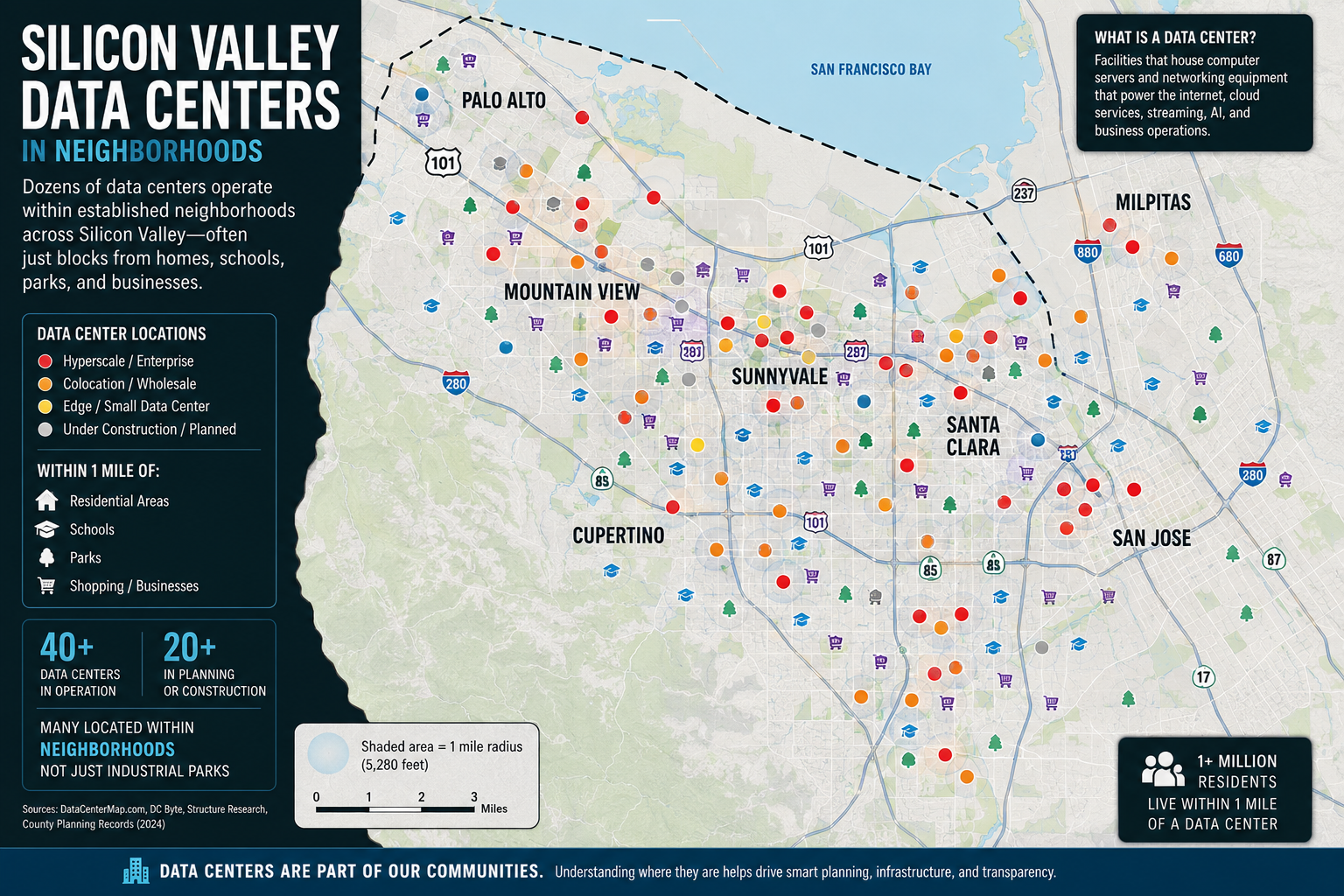
Start in Silicon Valley
If America’s technology executives are carefully insulating themselves from data centers, Silicon Valley ought to be an interesting place to look.
It is, after all, where many of those executives live.
It’s also crawling with data centers.
Equinix operates multiple facilities in Silicon Valley. Digital Realty says it operates 15 data centers in its Silicon Valley market. CoreSite operates facilities in Santa Clara, San Jose and Milpitas. Vantage operates two large Santa Clara campuses.
Santa Clara is one of the largest concentrations of data-center infrastructure in the country.
And then there is Palo Alto.
That’s where the viral map begins to fall apart.
Equinix operates a data center called SV8 at 529 Bryant Street in Palo Alto.
Not somewhere out beyond the subdivisions.
Downtown Palo Alto.
Equinix describes SV8 as a 26,296-square-foot colocation facility. It isn’t one of the enormous gigawatt-scale AI campuses now being proposed around the country, but it is unquestionably a data center.
And Equinix says its cooling infrastructure can support high-density and AI workloads.
Now let’s look around the neighborhood.
Hello, Mark
Mark Zuckerberg is publicly reported to live in Palo Alto’s Crescent Park neighborhood.
I’m deliberately not giving his street address. We don’t need it. We have Robb Report, he lives, “just 10 minutes from [Meta] platform’s Menlo Park HQ.”
The City of Palo Alto identifies Crescent Park and its location. Take a geographic reference point for the neighborhood and measure the distance to Equinix SV8.
It’s roughly a mile.
The exact distance from Zuckerberg’s house isn’t the point.
The point is considerably simpler.
Crescent Park itself is well inside a five-mile radius of an operating data center.
Put a red dot on the map.
Then there’s Larry Page, Google’s co-founder.
Page has long been publicly associated with the Old Palo Alto neighborhood.
Again, forget his house. Use the neighborhood.
Old Palo Alto is roughly a mile or so from SV8, depending upon where in the neighborhood you measure.
Another red dot.
Forbes currently lists LinkedIn co-founder Reid Hoffman as a Palo Alto resident as well.
Then move outward.
Public sources place NVIDIA CEO Jensen Huang in Los Altos. Google co-founder Sergey Brin has been associated with Los Altos. Alphabet CEO Sundar Pichai has been publicly reported in Los Altos Hills. Former Meta executive Sheryl Sandberg has been associated with Menlo Park.
Now the original blank map is starting to look pretty silly.
But I wouldn’t put every one of those people inside a five-mile circle without verifying the geography first.
That’s the difference between making a map and making a meme.
Then I mapped the data centers
Once you start plotting the actual infrastructure, another picture emerges.
There isn’t some great empty moat separating Silicon Valley’s wealthy residential communities from the infrastructure that makes Silicon Valley possible.
Data centers run through the region.
Equinix has facilities in Palo Alto, Sunnyvale, Santa Clara and San Jose.
CoreSite has a substantial Silicon Valley presence. Its SV9 facility in Santa Clara is a 228,000-square-foot data center certified to support NVIDIA DGX infrastructure.
Vantage’s CA1 campus in Santa Clara contains six data-center buildings totaling about 335,000 square feet and 77 megawatts of critical IT capacity. Its nearby CA2 campus adds another three buildings and 75 megawatts.
Digital Realty’s SC1 facility at 2220 De La Cruz Boulevard in Santa Clara alone contains about 471,000 square feet.
And that’s nowhere near the complete inventory.
Plot those facilities on a map.
Then draw a five-mile circle around each one.
Suddenly the idea that technology executives somehow inhabit a data-center-free Silicon Valley becomes difficult to maintain.
The red dots aren’t missing.
The meme-maker deliberately didn’t put them there.
But here’s where the argument gets more complicated
There is a legitimate debate buried underneath this bad map.
We have started using the words data center to describe things that can be radically different from one another.
The Palo Alto facility isn’t Project Matador in Texas.
It isn’t Meta’s enormous Hyperion campus in Louisiana.
It isn’t one of the new AI campuses being discussed in terms of hundreds of megawatts—or eventually gigawatts—of electricity.
A traditional enterprise or colocation data center might occupy an ordinary-looking building in an established commercial district.
A hyperscale AI campus can cover hundreds or thousands of acres and require power infrastructure comparable to that of a substantial city. Depending upon its cooling design, it can also create significant water demands. Transmission lines, substations, generators and new power plants can become part of the equation.
Those distinctions matter.
In fact, they may explain something genuinely important happening across America.
Pew Research Center recently examined more than 3,000 operating U.S. data centers and found that 38 percent of Americans already live within five miles of one.
Think about that for a moment.
Nearly four out of every ten Americans.
Pew also found that 87 percent of existing data centers are in urban areas.
The new generation looks different.
Among planned data centers, Pew found 67 percent are in rural areas.
Now that’s a story.
The infrastructure supporting the internet, cloud computing and corporate IT grew largely around metropolitan areas, telecommunications networks and concentrations of customers.
The infrastructure required for the AI era increasingly goes looking for something else:
Land.
Power.
Transmission.
Water or alternative cooling capacity.
And enormous amounts of room for expansion.
That pushes some of the biggest projects toward rural America.
There is a perfectly legitimate question to ask about whether executives approving those enormous projects would want a 500-megawatt or 1-gigawatt AI campus built next to their own neighborhood.
Ask it.
Investigate it.
Map it.
But don’t pretend that question has already been answered by drawing a blank map of the United States.
There’s another irony
Every one of those executives lives in a world made possible by data centers.
So do I.
So does the person who created the deceiving meme.
And so does everyone who shared it.
That map traveled from a server, through fiber-optic networks and telecommunications infrastructure, onto somebody’s smartphone, where it was uploaded to a social-media platform whose operation depends upon enormous computing infrastructure.
It was then copied, stored, processed and served to thousands or perhaps millions of other phones and computers.
Somewhere, racks of servers did the work.
The meme arguing that technology executives don’t live near data centers could not exist without data centers.
That’s worth remembering.
Because there’s a serious national debate underway about where we put the enormous computing infrastructure America is going to need.
Communities have every right to ask what a proposed facility will do to their electricity rates, water supply, tax base, noise levels, roads and landscape.
Developers should have to answer those questions.
Politicians should have to answer them.
Technology companies should have to answer them.
But those arguments deserve facts.
I started with a viral map containing no red dots.
Then I looked at the data centers.
Then I looked at Silicon Valley.
And within a few minutes, I found Mark Zuckerberg’s neighborhood roughly a mile from an operating data center. Larry Page’s neighborhood is roughly the same.
There are plenty more dots to investigate.
So perhaps the most revealing thing about that viral map isn’t what it shows.
It’s what whoever made it decided not to show.