
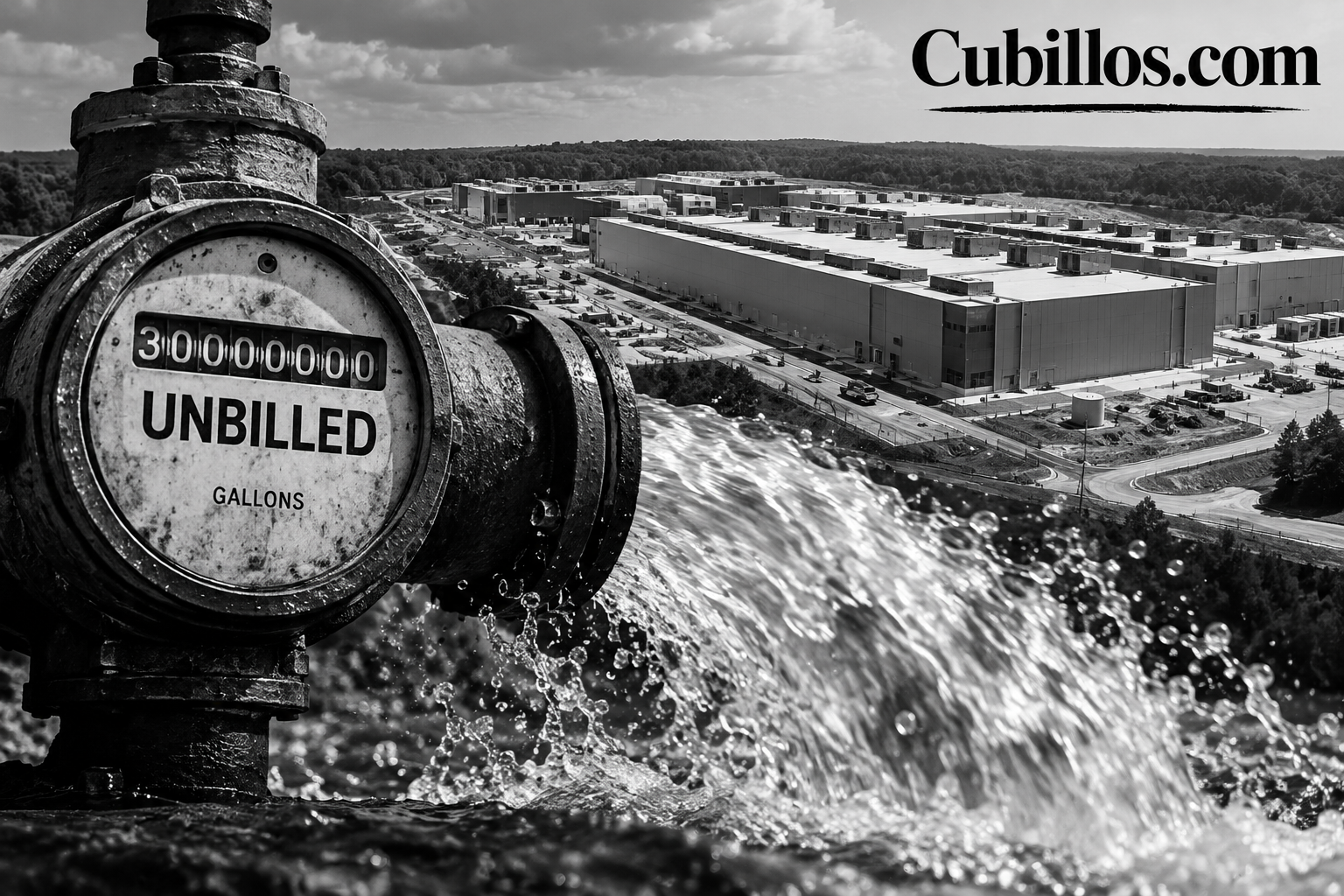
In Georgia, a giant data center used millions of gallons of municipal water that went unbilled. The company paid up. The county explained itself. But the questions didn’t disappear.
There are certain things you expect your local government to keep track of. Property taxes. Building permits. Whether your grass is two inches too tall.
And water.
Especially 30 million gallons of it.
But down in Fayetteville, Ga., about 20 miles south of Atlanta, the county water department managed to lose track of nearly that much water flowing into a massive data center development.
Not a leaky garden hose. Not somebody filling a swimming pool without telling the neighbors.
Twenty-nine million gallons.
That’s enough to fill roughly 44 Olympic-size swimming pools.
And for a while, nobody was sending a bill.
A Little Water Problem
The customer was QTS, a major data center developer owned by Blackstone, one of the world’s largest investment firms.
QTS is building a 615-acre data center campus in Fayetteville, with plans for as many as 16 buildings.
That’s not a computer room. That’s practically a small industrial city.
Some of the facilities are already operating, while construction continues across the property.
The project promises economic development, tax revenue and the sort of technological future that politicians love to stand in front of while somebody takes their picture.
It also requires water.
Lots of it, at least during construction.
The trouble began when residents in a nearby neighborhood complained about low water pressure.
County officials investigated and discovered two water connections associated with the data center that weren’t being properly accounted for.
A May 2025 letter from the county water system suggested that one connection had been installed without the utility’s knowledge or inspection.
Another wasn’t properly connected to the billing system.
By the time the accountants caught up, QTS owed $147,474.
Now, if you forget to pay your household water bill, the county generally has a fairly efficient way of getting your attention.
They send notices.
Eventually, they can turn off your water.
But when you’re building a multibillion-dollar industrial complex, apparently it takes a little longer for somebody to notice that the meter isn’t talking to the computer.
Nobody Stole Anything
Before somebody starts shouting about corporate water thieves, there’s an important detail.
The evidence doesn’t establish that QTS stole any water.
The county subsequently explained that the problem occurred during its transition to a new smart-meter system.
Fayette County was upgrading approximately 33,000 water meters. Some connections were still tied to the old system and weren’t properly incorporated into the new one.
County officials said the connections had been inspected and the earlier letter was misleading.
QTS was billed retroactively at the county’s construction water rate, twice the normal retail rate.
The company paid.
No criminal wrongdoing has been alleged.
So this wasn’t necessarily a case of a corporation sneaking around in the middle of the night with a wrench and a length of pipe.
It was a government water department that couldn’t properly account for water being delivered to one of its largest industrial customers.
Which, come to think of it, isn’t particularly reassuring either.
Then Came Another 109 Million Gallons
The story might have ended with an embarrassing billing mistake and a check for $147,474.
Except the reporters kept digging.
In July, Atlanta News First examined county billing records and discovered that QTS had been billed for approximately 109 million gallons of water across 13 connections since the development began receiving water in February 2024.
That’s considerably more than the original 29 million gallons that attracted public attention.
And here’s where the distinction between building a data center and operating one becomes important.
QTS says much of that water was used for construction.
Concrete work. Dust suppression. Site preparation.
Those are legitimate construction activities, particularly on a project covering hundreds of acres.
The company also says its completed data centers will use closed-loop cooling systems that recirculate water rather than continuously consuming fresh municipal supplies for cooling.
Once construction is finished, QTS estimates that its domestic water consumption will be comparable to that of four American households.
That’s roughly 9,000 to 12,000 gallons per month.
Quite a difference from the millions of gallons already used during construction.
But there’s a catch.
The development isn’t expected to be completed until 2030.
Which means the construction water demand and the promised low-water future are two different things.
And there’s nothing wrong with asking how much water a project will consume getting from one to the other.
The Closed-Loop Sales Pitch
Closed-loop cooling is becoming a favorite talking point in the data center industry.
And for good reason.
Traditional evaporative cooling systems can consume substantial amounts of water. Closed-loop systems can dramatically reduce that demand by circulating the same cooling fluid repeatedly.
That’s a genuine technological improvement.
But a closed-loop cooling system doesn’t mean a data center development uses no water.
It doesn’t eliminate the water needed to mix concrete, control construction dust, prepare land, supply bathrooms or maintain other facilities.
And it doesn’t answer questions about the electricity required to operate the cooling equipment.
Those are separate costs, and somebody ought to be counting them.
QTS says its Fayetteville campus will eventually have a very small municipal water footprint.
Fine.
Let’s hope it does.
But until construction is finished, the relevant question isn’t simply how much water the cooling system will use someday.
It’s how much water the entire project is using today.
The County Says Everything Is Fine
Fayette County officials say QTS uses less than 1 percent of the county water system’s monthly production.
The county is permitted to produce approximately 22.8 million gallons per day and currently produces about 17.3 million.
Officials also say the data center does not affect residential water pressure.
Those are important facts.
The water system has capacity beyond its current production, and the county disputes any connection between QTS and the neighborhood pressure complaints.
There’s no reason to ignore those explanations.
But there’s also no reason to stop asking questions.
If a county can lose track of nearly 30 million gallons during a billing-system conversion, how confident should residents be in its ability to monitor industrial water demand as the project expands?
And if a developer promises that water consumption will fall dramatically after construction, who’s responsible for checking whether that actually happens?
The company?
The county?
Or the homeowners who have to file public-records requests to find out what’s going on?
The Real Problem Isn’t the Missing Bill
The original accusation that QTS stole 30 million gallons of water makes for a terrific social media headline.
It’s also unsupported by the available evidence.
The company received a bill and paid it.
The county acknowledged its administrative failure.
That part is settled.
What isn’t settled is whether local governments across the country are adequately prepared to oversee industrial developments of this scale.
A data center can require hundreds of acres, enormous electrical capacity, substantial construction resources and years of infrastructure work before its operators switch on the last server.
Those demands don’t disappear because the finished building has an efficient cooling system.
And the public shouldn’t have to wait until something goes wrong to find out what the project is consuming.
Fayette County says its meters are now properly connected and the billing system is working.
Good.
That’s what taxpayers were paying for in the first place.
But the next time a county approves a development that promises to transform the local economy, perhaps somebody ought to ask a few questions before the bulldozers arrive.
How much water will construction require?
How much electricity will the finished project consume?
Who pays for infrastructure improvements?
And who’s keeping track?
Because when a government can misplace the billing for 30 million gallons of water, you have to wonder what else nobody’s counting.