
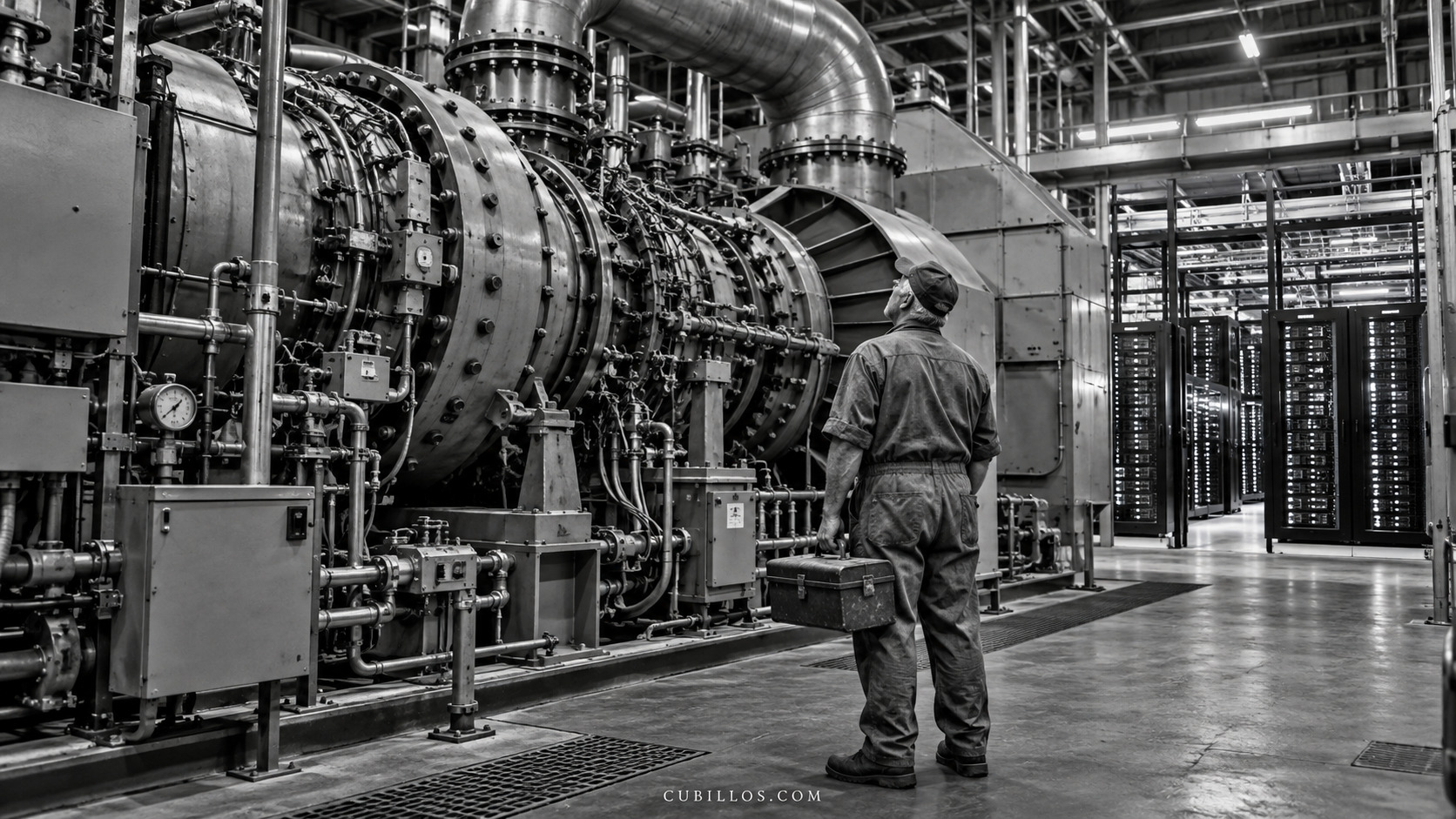
Silicon Valley figured out how to build its own power plants. Now it’s discovering that you can’t fix a broken turbine with a software update.
Back in June, I wrote that folks were looking at the wrong thing when they talked about data centers. Everybody was staring at those enormous windowless buildings going up outside town, when they ought to have been looking at the power plants, transmission lines, pipelines and water systems needed to keep the computers humming.
In September, I returned to the subject with a column titled “Folks, It Still Ain’t About the Data Center Building.”
By then, the technology companies had discovered that America’s electrical grid couldn’t deliver all the electricity they wanted on their preferred schedules. So they came up with a solution.
Build their own power plants.
I called that section of the column “The cloud discovered the turbine.”
Well, folks, apparently the cloud has now discovered the repairman.
And he’s going to be expensive.
When the turbine goes crack
On Oct. 28, Catherine Boudreau of Latitude Media reported something rather interesting about the rush to build natural-gas power plants for artificial intelligence.
Some of the turbines are breaking.
Not metaphorically. Actual cracks in actual machinery.
According to the report, power companies and engineering contractors are receiving an increasing number of calls from data center developers whose generating equipment has developed mechanical problems.
It seems some of these folks know considerably more about operating computers than operating industrial power plants.
Who could have imagined?
At Elon Musk’s xAI Colossus campus in Memphis, gas turbines reportedly developed cracks. At the Stargate project in Abilene, Texas, developers encountered problems with backup turbines and cooling equipment.
And at a Vantage data center in Loudoun County, Va., a critical power failure reportedly forced the facility to rely on diesel generators for nearly 24 hours.
The neighbors complained about the noise and air pollution.
Imagine being told that a quiet, modern data center is coming to your neighborhood, only to discover that when the machinery acts up, you’ve got diesel generators roaring away like a truck stop at quitting time.
Welcome to the cloud.
Everybody wants to be a power company
The numbers are something to behold.
Cleanview, which tracks data center development, estimates that developers have roughly 110 gigawatts of on-site natural-gas generating capacity in their project pipeline.
Last summer, the figure was about 20 gigawatts.
That’s more than a fivefold increase in proposed generating capacity in a little over a year.
Not all those projects will get built, of course. Developers have been known to announce grand plans that never get much farther than a press release and a fellow pointing at a map.
Still, 110 gigawatts is an enormous amount of potential electricity generation.
And much of it is being proposed by companies whose principal business is processing information, not producing electricity.
One of the more entertaining observations in Boudreau’s report came from Sheldon Kimber, founder of Intersect, an energy developer acquired by Google.
Kimber complained that the business is attracting people with little experience developing large power plants.
Apparently, all it takes to become a power company these days is a patch of Texas dirt, access to natural gas and the telephone number of somebody who sells turbines.
Experience is optional. Optimism is mandatory.
Kimber described much of the development pipeline in terms considerably less flattering than those used in corporate annual reports.
He has a point.
There’s a difference between owning land near a pipeline and knowing how to build and operate a reliable generating facility.
It’s rather like buying a Boeing 747 and deciding that makes you an airline.
Eventually, somebody is going to ask who’s flying the thing.
Electricity doesn’t care about your stock price
Here’s where the story gets particularly interesting.
Artificial intelligence creates some unusual demands on electrical systems.
Thousands of processors working together can suddenly require enormous amounts of electricity. A moment later, the demand drops. Then it jumps again.
These fluctuations can involve megawatts of power in milliseconds.
Computers are quite comfortable doing things in milliseconds.
Gas turbines, being large pieces of industrial machinery rather than mathematical abstractions, have a different opinion.
They operate at enormous temperatures and rotational speeds, and they prefer electrical loads that don’t behave like a jackrabbit on a hot griddle.
Rapid fluctuations can stress generating systems unless engineers design equipment and controls to manage them.
That doesn’t mean every cracked turbine was damaged by AI workloads. Mechanical failures can have several causes, and the individual incidents require their own investigations.
But the fluctuations are a recognized engineering problem.
Which is why some developers are installing large batteries alongside their gas turbines. The batteries absorb sudden changes in demand, allowing the turbines to operate more steadily.
Think about that for a moment.
The technology companies couldn’t get enough electricity from the grid, so they decided to build their own power plants.
Now they’re discovering that their computers can make operating those power plants more complicated, so they’re adding batteries to keep the machinery happy.
At this rate, somebody’s going to rediscover the public utility.
Somebody has to turn the wrench
There’s another little detail that seems to have escaped some of the industry’s more enthusiastic promoters.
Power plants require maintenance.
Actual maintenance.
Not the kind where somebody in a polo shirt asks whether you’ve tried restarting the computer.
Gas turbines require mechanics, electricians, engineers, control-system specialists and experienced operators who understand what happens when machinery operating at thousands of revolutions per minute begins making a noise it shouldn’t.
These people don’t grow on trees.
And you can’t create one by giving a software engineer a toolbox and a motivational speech.
Jon Parella, CEO of TerraFlow Energy, told Latitude Media that the industry already faces challenges finding enough electrical contractors and heating and cooling technicians to build these enormous facilities.
Then comes the need for mechanics who can maintain and service the generating equipment.
There’s a problem worth considering.
America already needs skilled workers to maintain its existing electrical system. Utilities need them. Factories need them. Refineries need them.
Now the AI industry wants to build a vast collection of private generating facilities, many on accelerated schedules, and expects those workers to materialize on demand.
Money can buy a turbine.
It can’t instantly buy 20 years of experience maintaining one.
And while Silicon Valley is quite good at attracting investment capital, it hasn’t yet figured out how to manufacture experienced industrial workers by the gigawatt.
The gas doesn’t come out of the computer
Even if every turbine worked perfectly, these developers would still face another problem.
Natural gas.
It has to come from somewhere.
It must be produced, processed, transported through pipelines and delivered to the generating facility.
And those pipelines have limits.
So does the available supply of gas under firm delivery contracts.
The AI companies are entering a market that already serves electric utilities, manufacturers, chemical plants, homeowners and exporters of liquefied natural gas.
Anthropic, one of the major AI developers, identified natural-gas prices, supply and pipeline constraints as risks to its expansion plans.
Imagine that.
A company developing some of the world’s most sophisticated artificial intelligence systems now has to worry about whether the gas company can deliver enough fuel.
The cloud has discovered the pipeline.
And pipelines, unlike investor presentations, have a maximum capacity.
The consequences extend beyond the data center fence. Competition for natural gas and pipeline capacity can affect other customers, depending on local markets and contracts.
That doesn’t automatically mean your electric bill will go up. But it does mean the decisions made by these private developers can have consequences for the larger energy system.
In September, I wrote that the electricity problem had merely moved behind the fence.
Apparently, the natural-gas problem followed it.
And what about the neighbors?
This is where the story stops being particularly funny.
Suppose a developer arrives at a county commission meeting with plans for a massive data center.
The presentation is impressive. There are architectural renderings, promises of investment and assurances that the project will generate much of its own electricity.
The commissioners hear that the facility won’t place enormous new demands on the local electrical grid.
Wonderful.
Somebody ought to ask what happens when the private power plant breaks down.
Will the facility switch to diesel generators? How many? For how long? What emissions are permitted? What happens to the noise levels?
And if the facility can draw backup electricity from the public grid, who pays for the infrastructure required to make that possible?
Those are the kinds of questions communities have been asking about industrial facilities for generations.
They aren’t radical questions.
They’re ordinary questions.
We’ve developed environmental regulations, operating standards and safety requirements because industrial machinery can fail, sometimes with consequences extending well beyond the property line.
A privately operated power plant doesn’t automatically escape those requirements simply because it sits behind a data center’s electric meter. But the rules vary by location, equipment and regulatory jurisdiction.
That’s why local officials need to understand exactly what they’re approving.
In September, I wrote about an Imperial Valley data center proposal that included 132 natural-gas generators, a substantial battery system and millions of gallons of water storage.
I said then that at some point you stop describing a computer facility and start describing an industrial power plant with servers attached.
I haven’t changed my mind.
A data center generating hundreds of megawatts of electricity isn’t merely a customer of the energy industry.
It’s part of the energy industry.
And the people living downwind ought to have something to say about it.
We’ve seen this movie before
There’s something familiar about the whole business.
During America’s great railroad expansion, investors poured money into laying tracks across the country. Railroad companies competed to build faster, farther and bigger.
But laying track wasn’t the same as operating a railroad.
That required engineers, mechanics, maintenance shops, dispatchers, signaling systems and workers who knew how to keep trains moving without killing everybody aboard.
The country learned some expensive lessons about what happens when ambition outruns experience.
The electrical industry has its own history of hard lessons.
Generations of engineers, utility workers, electricians and mechanics built the system Americans depend upon today.
They developed standards, established operating procedures and learned from equipment failures.
That’s why most of us can walk into a room, flip a switch and reasonably expect the lights to come on.
It didn’t happen by accident.
And it didn’t happen because somebody with a few billion dollars announced that electricity was the next big thing.
Now a new generation of technology companies is entering the power business, apparently convinced that industrial experience is something they can acquire along with the equipment.
Some will succeed. Others may discover that buying the machinery was the easy part.
The rest of us ought to be interested in which is which, particularly when these facilities are being built near our homes.
Call it what it is
I keep coming back to the language.
Cloud computing. Artificial intelligence. Digital infrastructure.
Lovely expressions.
They make the whole enterprise sound clean and weightless, as though the computers were floating somewhere above us, quietly contemplating the mysteries of the universe.
Meanwhile, down here on Earth, somebody is digging trenches for pipelines, installing gas turbines, building substations, pouring concrete, drilling wells and trying to figure out why a piece of machinery that costs millions of dollars has developed a crack.
There’s nothing inherently wrong with industrial development.
America needs investment in infrastructure. We need electricity. We need advanced computing, and artificial intelligence may produce substantial benefits in medicine, science, manufacturing and other fields.
But let’s quit pretending this is merely a digital enterprise.
These are industrial facilities with industrial demands, industrial risks and industrial consequences.
Calling the electricity private doesn’t make the emissions disappear.
Calling the facility a data center doesn’t turn a gas turbine into a computer.
And calling something the cloud doesn’t mean it floats.
The fellow with the toolbox
Back in June, I argued that we were looking at the wrong building.
In September, I argued that electricity was the larger story.
Now we’re discovering what happens when the AI industry’s ambitions collide with the ordinary requirements of industrial operations.
Equipment wears out. Machinery breaks. Fuel prices change. Pipelines become congested.
And somebody has to maintain the whole contraption.
There’s a certain irony in watching an industry that promises to transform human labor discover just how much it depends on people who work with their hands.
Not the executives making billion-dollar announcements.
Not the investors calculating their returns.
The mechanics. The electricians. The turbine technicians. The engineers who know the difference between a minor vibration and a machine preparing to scatter expensive parts across the countryside.
Those are the people who keep industrial America running.
And they were doing it long before anybody thought to call a warehouse full of computers the cloud.
The smartest computers in human history are waiting for a fellow with a toolbox.
There’s probably a lesson in that somewhere.