
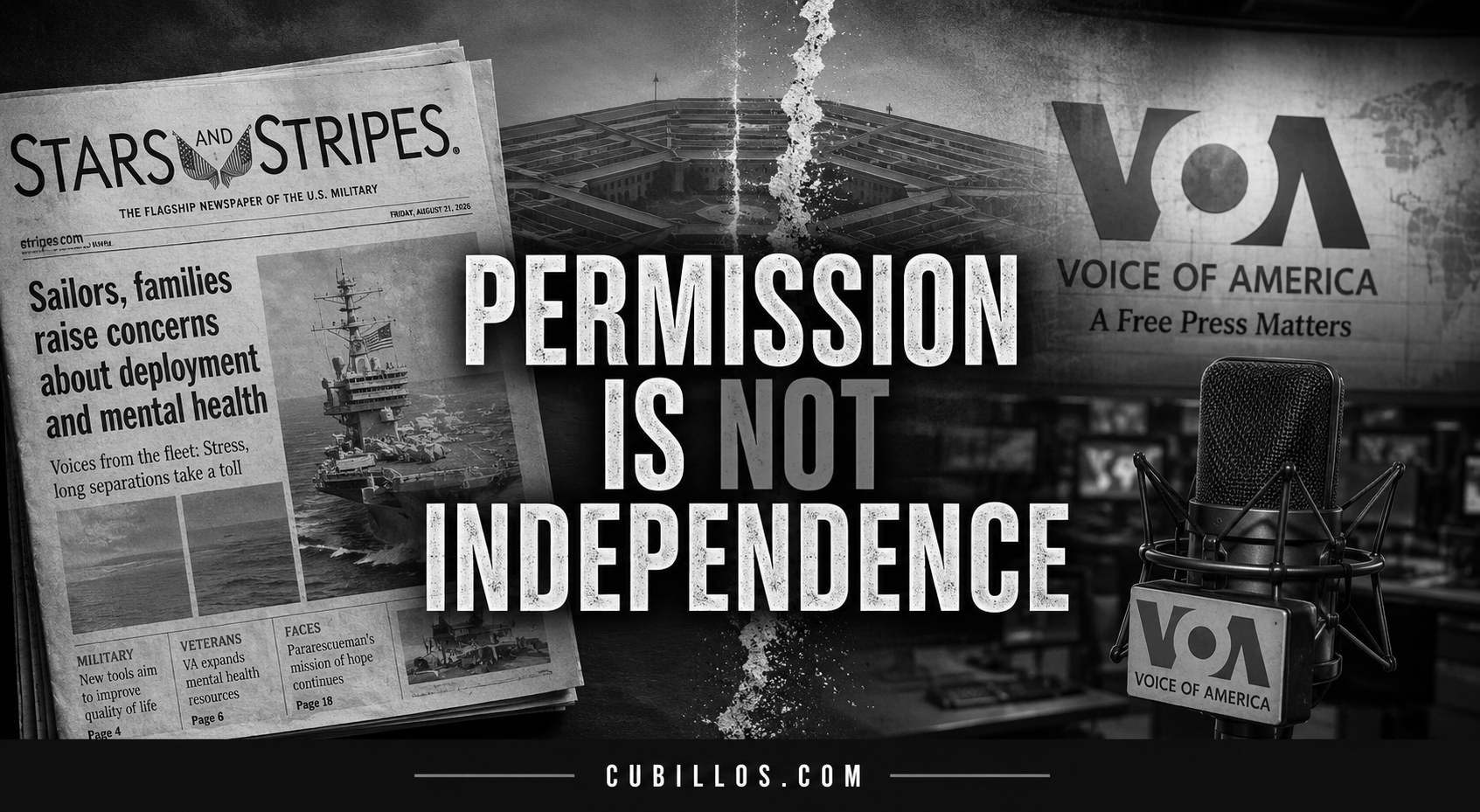
For more than 80 years, the United States has maintained an unusual proposition: The government can pay journalists without owning their journalism.
It was never a particularly comfortable arrangement. It wasn’t supposed to be.
Voice of America was created during World War II to carry American news and ideas beyond our borders. Stars and Stripes has an even older lineage, dating to the Civil War, and has continuously served American troops since World War II.
Different audiences. Different missions.
But both rested on a remarkably similar principle.
Government-funded journalism does not have to be government-controlled journalism.
We may be watching that distinction disappear.
The Trump administration moved against Voice of America in March 2025 as part of an executive order reducing several federal agencies. The U.S. Agency for Global Media, VOA’s parent organization, announced that it would reduce itself and the outlets it oversees to what it described as the “minimum presence and function required by law.” Most employees were placed on administrative leave.
The effort amounted to a near shutdown of an American broadcasting institution that had operated since 1942.
The courts eventually intervened.
In March of this year, U.S. District Judge Royce Lamberth ruled that the wind-down was unlawful and ordered more than 1,000 employees back to work. The legal battle demonstrated something easily forgotten in Washington: Congress also has something to say about whether an institution created and funded by the government continues to exist.
Now there is Stars and Stripes.
On Friday, the Pentagon moved to fire three people at the top of or closely associated with the newspaper’s journalism: publisher Max Lederer, editor-in-chief Erik Slavin and Middle East reporter Lara Korte.
The Pentagon cited insubordination.
Slavin and Korte say their alleged insubordination stems from an interview they gave CBS News.
What did they say?
Nothing particularly revolutionary for journalists.
Korte explained that she worked for Stars and Stripes, not the Pentagon, an administration or policymakers.
Slavin was asked where he would draw the line on Pentagon interference. His answer was essentially this: If the Pentagon told him not to run an accurate story and instead handed him the version it wanted published, that would cross the line.
For defending that principle publicly, they now face losing their jobs.
That ought to bother anyone who understands why Stars and Stripes exists.
A Newspaper Inside the Military
Stars and Stripes occupies one of the strangest places in American journalism.
It operates within the Department of Defense. Its journalists cover the same military establishment that helps pay the bills. Yet Congress and the Pentagon itself have established protections intended to preserve its editorial independence.
There is a reason for that.
The military already has public affairs offices.
It has command information programs.
It has official websites, social media accounts, press releases, speeches, photographs and videos.
Those things have legitimate purposes. But they aren’t independent journalism.
Stars and Stripes is supposed to be something different.
A young sailor aboard a carrier in the Arabian Sea should be able to pick up Stripes and reasonably believe the story he is reading wasn’t rewritten because an admiral, secretary or political appointee didn’t like it.
That’s the bargain.
And recently that bargain has been getting increasingly uncomfortable.
Earlier this year, the Pentagon announced a “modernization” of Stars and Stripes. The department has criticized some of its journalism as “woke.” In April, the Pentagon fired Jacqueline Smith, the newspaper’s ombudsman — a position Congress established to help safeguard editorial independence.
Then came Friday’s firings.
There is an additional wrinkle that anyone following the USS Abraham Lincoln should notice.
Stars and Stripes was among the publications reporting on difficult conditions aboard the carrier during its extraordinarily long Middle East deployment, including concerns raised by military families about mental health and self-harm.
The administration disputed or downplayed portions of that reporting.
Yet Navy Capt. William Urban, recently installed as military deputy to the Stars and Stripes publisher, has pointed to the Lincoln coverage as evidence that the Pentagon remains committed to editorial independence.
His argument deserves examination.
There was time, Urban said, between the original Lincoln story and subsequent reporting for Pentagon leadership to shut down the coverage if it wanted to.
It didn’t.
Therefore, he suggested, journalists should take the Pentagon at its word that their independence will be respected.
I see it differently.
Permission Is Not Independence
The Pentagon’s decision not to stop a story isn’t proof of editorial independence.
The Pentagon having no authority to stop the story is.
That’s the difference between independence and permission.
If an editor sits at his desk wondering whether the Pentagon will permit the next story to appear, the battle has already been lost.
It doesn’t matter whether the story ultimately runs.
The government has become the editor.
That is precisely why the Voice of America experience matters.
VOA wasn’t created to tell foreign audiences that the United States never makes mistakes. Its credibility depended upon audiences believing they were hearing journalism rather than a government sales pitch.
That distinction was strategically valuable.
Anybody can broadcast propaganda.
The harder thing is allowing journalists whose paychecks ultimately come from the government to report things that embarrass the government.
America spent decades arguing that it could do exactly that.
And Stars and Stripes demonstrated the same principle in an even more remarkable environment.
The United States military is built around obedience to lawful orders. A lieutenant obeys a commander. A sailor obeys the chief. The chain of command isn’t optional.
Journalism cannot work that way.
An editor cannot be subordinate to the person his reporters are covering and still function as an independent editor.
A reporter cannot be required to protect the institution she covers from embarrassment and still honestly tell readers she is independently covering it.
That doesn’t mean journalists are above accountability.
They aren’t.
Reporters can get stories wrong. Editors can exercise terrible judgment. Government employees can violate legitimate workplace rules. Stars and Stripes should be no more immune from criticism than The Washington Post, Fox News, The New York Times or the smallest hometown weekly.
But the government cannot establish an independent newsroom and then treat editorial independence itself as insubordination.
Those ideas cannot comfortably occupy the same room.
The Audience Matters
There is another reason Stars and Stripes deserves special protection.
Its readers wear uniforms.
Those readers live within the very system the newspaper covers.
A sailor cannot publicly criticize his commanding officer the way a civilian can criticize his mayor. A soldier cannot simply walk away from his employer. Military personnel live under rules and restrictions the rest of us don’t.
That makes independent reporting about their lives more important, not less.
Sometimes the stories will make commanders angry.
Sometimes they’ll make politicians angry.
Sometimes they’ll make sailors angry.
That’s journalism.
I spent much of my career reporting on the military, and one lesson became obvious very quickly: If all you do is talk to the brass, you’re going to get a very different Navy, Army, Air Force or Marine Corps than the one you’ll find talking to the people turning wrenches, standing watches and sleeping in crowded berthing compartments.
Both perspectives matter.
Stars and Stripes has been uniquely positioned to provide them.
That is why the firing of three people shouldn’t be dismissed as another personnel dispute inside the Pentagon.
Nor should it simply become another partisan story about Donald Trump and the press.
There’s something larger happening.
First came the attempted dismantling of Voice of America.
Now the leadership and editorial independence of Stars and Stripes are under extraordinary pressure.
Two institutions. Two different missions. One important principle.
For generations, the United States told the world there was a difference between state-funded journalism and state-controlled journalism.
Voice of America was supposed to demonstrate that distinction overseas.
Stars and Stripes was supposed to demonstrate it to our own troops.
The test of that principle isn’t whether government leaders like the journalism they’re paying for.
The test comes when they hate it.
Independent journalism exists precisely for that moment.
Because when a journalist can publish only because the government chooses not to stop him, he isn’t independent.
He has permission.
And permission can always be withdrawn.