
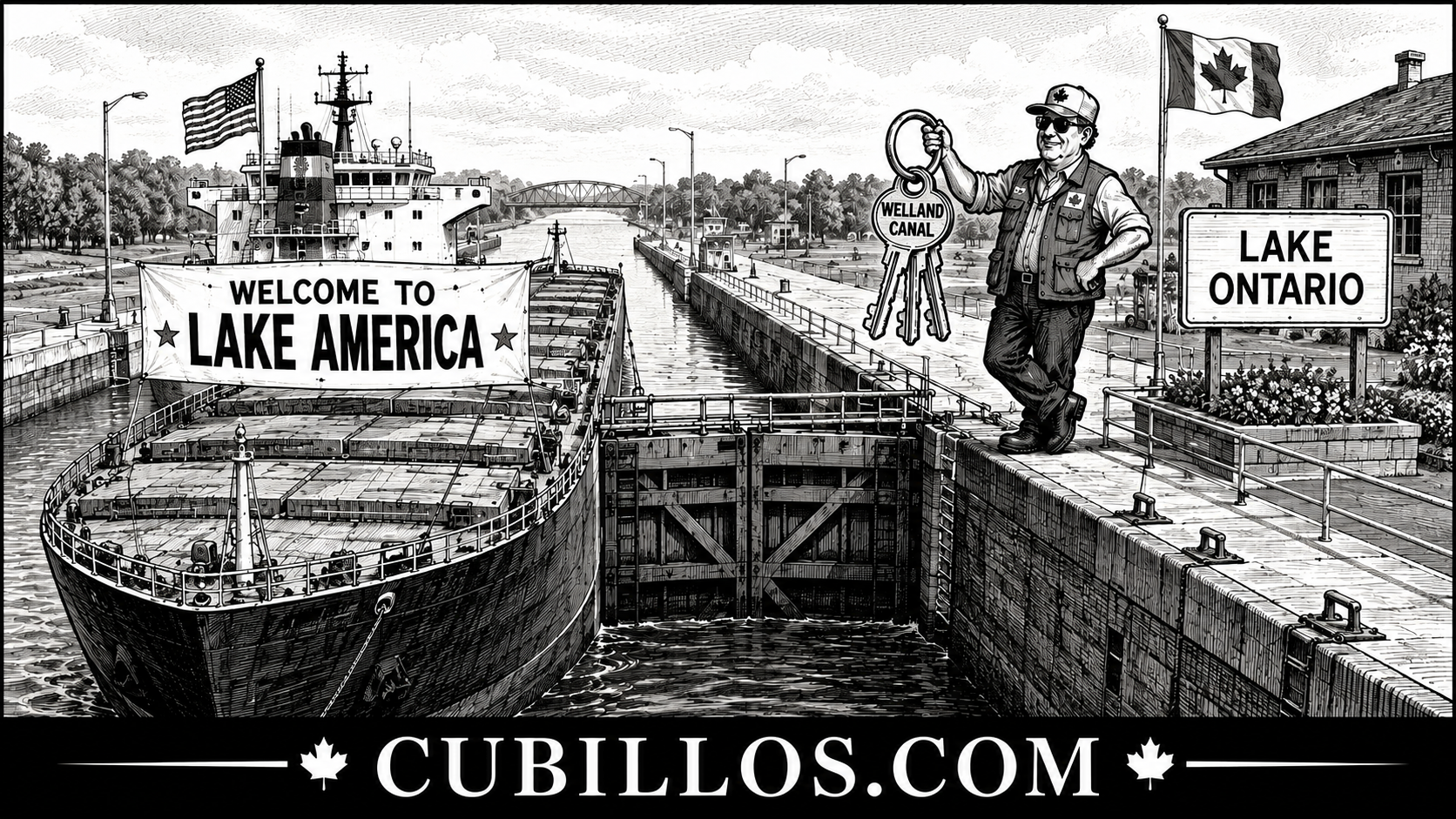
President Donald Trump has renamed Lake Ontario.
It is now, according to the United States government, Lake America.
Well, sure.
Why not?
We have apparently reached the point in international diplomacy where the State Department can be replaced by a label maker.
There are, however, a couple of small problems.
Canada owns half the lake.
Canada isn’t changing the name.
And if you want to take a ship from our newly christened Lake America into the upper Great Lakes, Canada owns the doors.
We’ll get to the doors.
First, there’s the name.
An Italian sails into the Great Lakes
Ontario isn’t some bureaucratic designation dreamed up by Canadian civil servants.
The name reaches back to the Indigenous peoples who lived around these waters long before anybody drew a border between the United States and Canada.
Look around the Great Lakes.
Erie takes its name from the Erie people.
Huron comes from the French name for the Wendat people.
Michigan derives from an Ojibwe word generally translated as “great water” or “large lake.”
Superior is the odd fellow in the group, coming from the French Lac Supérieur — the upper lake.
Then we get to Ontario, another name with Indigenous roots, generally traced to an Iroquoian or Huron-Wendat word describing a great or beautiful lake.
These names survived French explorers, British soldiers, American revolutionaries, the War of 1812, two world wars and generations of politicians.
Until now.
Because apparently what the Great Lakes were missing was an Italian.
America, after all, takes its name from Amerigo Vespucci.
Amerigo was a Florentine explorer whose first name was Latinized into Americus. A German cartographer put the feminine version — America — on a map in 1507.
The name stuck.
Quite successfully, as it turned out.
The fellow already got North America and South America.
Now he gets a lake.
Somewhere Amerigo Vespucci must be saying:
Hey, don’t drag me into this. I’ve already got two continents.
Two fishermen, two lakes
There is another minor geographical complication.
The international boundary runs through Lake Ontario.
Canada is on one side.
The United States is on the other.
President Trump can order American federal agencies to call the thing Lake America.
He cannot order Canada to do so.
This produces the marvelous possibility of an American fisherman sitting in his boat on Lake America while a Canadian fisherman 50 yards away sits on Lake Ontario.
Same water.
Same fish.
Different lake.
One can only imagine the confusion among the trout.
“Where were you caught?”
Depends on which direction I was swimming.
Unfortunately, Canada has the keys
A Canadian pointed out something to me that makes this entire business even better.
The locks at St. Catharines belong to Canada.
These are the locks of the Welland Canal, the great engineering staircase connecting Lake Ontario with Lake Erie while bypassing Niagara Falls.
This is important because attempting Niagara Falls in a 700-foot freighter tends to ruin the captain’s day.
There are eight locks on the Welland Canal.
All eight are in Canada.
The infrastructure belongs to the Canadian government and is operated by the St. Lawrence Seaway Management Corporation.
This presents a slight logistical problem with Lake America.
Picture an American freighter steaming proudly westward.
The Stars and Stripes snaps from the mast.
The captain looks at his freshly updated federal chart.
LAKE AMERICA.
By God, that sounds magnificent.
Perhaps somebody plays Lee Greenwood over the ship’s speakers.
The vessel reaches the western end of Lake America and prepares to continue toward Lake Erie.
And there stands Canada.
With the lock.
“Good morning.”
“We’re coming through.”
“Certainly. Where are you arriving from?”
“Lake America.”
“Never heard of it.”
“It’s right behind us.”
“Oh. Lake Ontario.”
“No. Lake America.”
“Would you like us to open the lock?”
Pause.
“Lake Ontario.”
There is something magnificently American about renaming a lake and then discovering somebody else owns the door.
And Canada owns most of the doors
It gets better.
The St. Lawrence Seaway has 15 locks between Montreal and Lake Erie.
Canada controls 13.
The United States operates two — Eisenhower and Snell at Massena, New York.
Let’s run that through the Department of Advanced Mathematics.
Canada: 13
United States: 2
This is what people in the military call a logistics problem.
Apparently nobody consulted the logistics people before we started renaming the water.
Once a ship crosses Lake Ontario — excuse me, Lake America — and wants to continue west, it reaches the Welland Canal.
Lock 1.
Canadian.
Lock 2.
Canadian.
Lock 3.
Still Canadian.
Locks 4, 5, 6, 7 and 8?
Also Canadian.
Trump could rename them Washington, Jefferson, Lincoln, Reagan, Trump, Trump II, Trump III and The Greatest Lock Ever Built.
They would still be in Canada.
Geography refuses to cooperate
Presidents can do quite a lot.
They can issue executive orders.
They can deploy armies.
They can impose tariffs.
They can appoint ambassadors.
They can change what federal agencies call geographic features.
But geography has a nasty habit of refusing to read executive orders.
Lake Ontario remains connected to Lake Erie by a canal running through Ontario.
Ontario remains in Canada.
Canada remains Canada.
The Niagara River continues flowing where nature put it.
This is the problem with governing by Sharpie.
Eventually you reach the edge of the map.
We built it together for a reason
There is a serious point hiding underneath all this foolishness.
The Great Lakes-St. Lawrence Seaway isn’t an American transportation system that happens to have some Canadians living along the shore.
It is a binational system.
Americans and Canadians spent generations figuring out how to move ships between the Atlantic Ocean and the industrial heartland of North America.
They signed agreements.
They built locks.
They dredged channels.
They established navigation rules.
They coordinated operations.
They did all those tedious things governments once did when they wanted something complicated to actually work.
And it worked.
An ocean-going vessel can sail from the Atlantic, up the St. Lawrence River, through a series of locks, across Lake Ontario, through the Welland Canal and into Lake Erie.
From there, the Great Lakes open the interior of the continent.
It works because two sovereign countries cooperate.
There was a time when Americans considered Canada our closest neighbor rather than an opponent in a naming contest.
Canada doesn’t have to do anything
That’s the beauty of the Canadian position.
Ottawa doesn’t have to retaliate.
Canada doesn’t need to rename anything.
It doesn’t need to call Lake Michigan “Lake Hiawatha.”
It doesn’t need to rename Lake Erie “Lake Sorry.”
It doesn’t even have to issue a strongly worded diplomatic note.
The Canadians possess a far more persuasive instrument of international diplomacy.
Lock Number One.
They can just keep calling it Lake Ontario.
And keep operating the locks.
Which brings us back to our American freighter.
It sails proudly across a lake whose new American name ultimately comes from an Italian explorer.
It reaches Canada.
It enters a Canadian canal.
It passes through Canadian locks.
And finally emerges into Lake Erie, whose name reaches back to the Indigenous people who lived there long before Donald Trump, Justin Trudeau, Amerigo Vespucci or anybody else thought North America needed international borders.
That’s quite a voyage through history.
Indigenous peoples named the waters.
Europeans drew the maps.
Americans and Canadians drew the border.
Engineers built the locks by hand.
Politicians renamed the lake.
And geography just sat there.
Which may be the wisest participant in the entire affair.
So welcome to Lake America.
Take some pictures.
Wave the flag.
Enjoy the view.
Just remember, if you’re headed west—
The Canadians have the keys.