
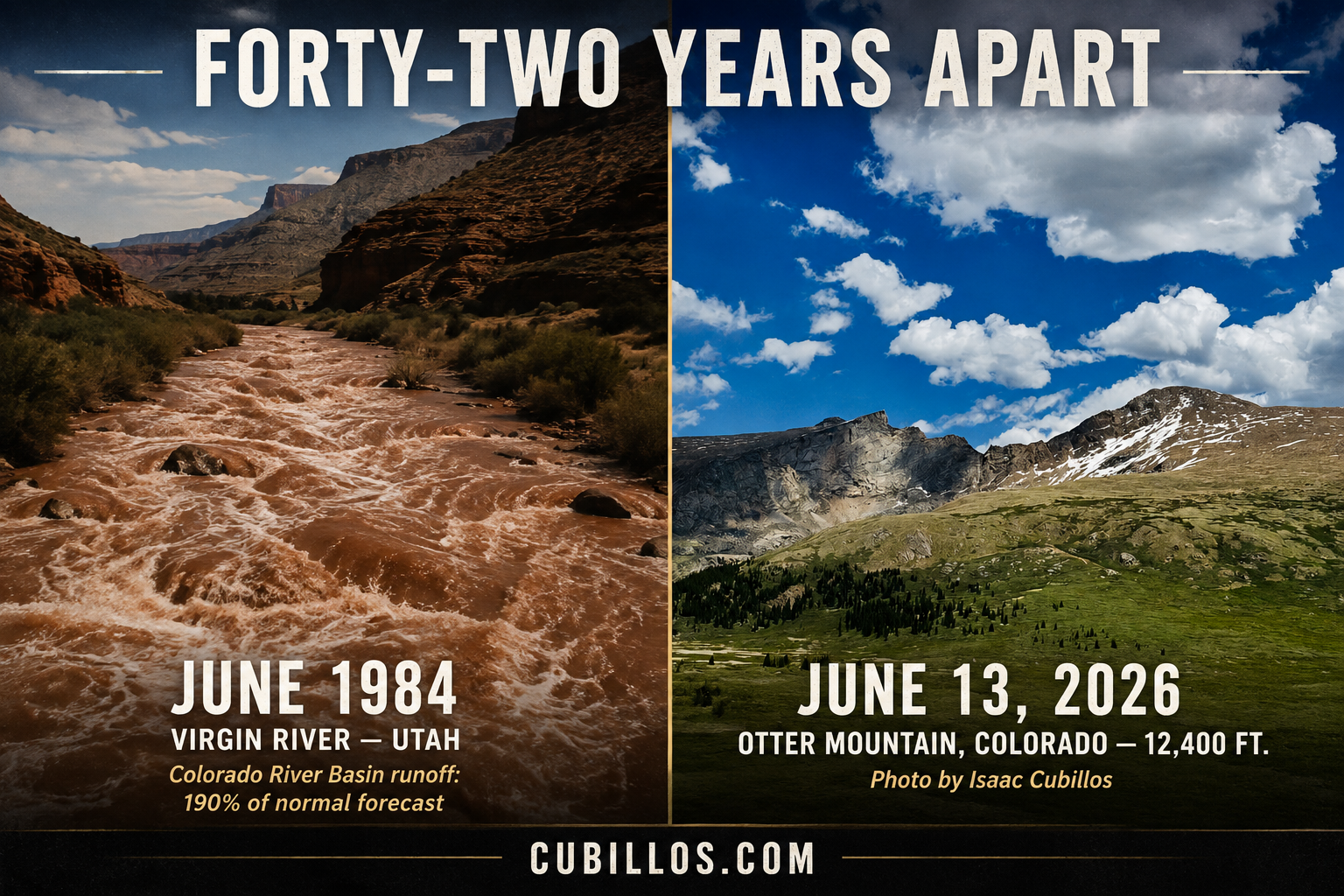
In June 1984, I was driving north on the I-15 out of Las Vegas toward Utah when I came upon something I have never forgotten.
The Virgin River was raging.
Not flowing. Not meandering politely through the desert. Raging.
It was red with silt, a muddy torrent cutting through country where water normally has the good manners to be scarce. The mountains had been packed with snow, the spring runoff was coming down, and the desert rivers were carrying it away as fast as gravity would allow.
I didn’t know the numbers then. I didn’t need to. I could see the water.
Forty-two years later, I was standing in Colorado looking up at the Fourteeners in June.
This time, what caught my attention was what I couldn’t see.
Snow.
There wasn’t much of it.
And I thought back to that red river in 1984.
Turns out my memory wasn’t playing tricks on me.
The Bureau of Reclamation’s records show just how extraordinary 1984 was. By June 7, the forecast for April-through-July runoff into Lake Powell had climbed to 14.2 million acre-feet — 190 percent of normal. A month later, the forecast went to 204 percent.
The actual April-through-July inflow into Lake Powell eventually reached more than 15.2 million acre-feet.
The Colorado River system had so much water that federal water managers were making flood-control releases from Hoover Dam.
Utah was swimming in it. In May 1984, streamflow at seven monitoring stations averaged two-and-a-half times the 30-year average. The Colorado River at Cisco, Utah, reached its highest flow since 1917.
The West had a problem in 1984.
Too much water.
Imagine that.
Now comes a study published this week in Communications Earth & Environment that helps explain why the mountains I looked at this June were so different from the West I remember from 1984.
Researchers examined snowpack, streamflow and irrigation demand across the western United States and tried to separate the effects of human-caused warming from the other things that make Western water such a glorious mess.
Their conclusion is startling.
From 2014 through 2024, human-caused climate change reduced April 1 snowpack across the West by roughly 36 percent and warm-season streamflow by about 13 percent.
Then the researchers went one step further.
They traced emissions associated with 122 major fossil-fuel producers and cement manufacturers — the so-called Carbon Majors — and calculated their contribution to those changes.
Their estimate: Emissions associated with those companies since 1950 account for roughly half of the water-supply changes the researchers attribute to human-caused climate change.
Put into water instead of percentages, they estimate those emissions are associated with about 12 million acre-feet less warm-season streamflow every year across the West.
That’s a number big enough to get even a Western water lawyer’s attention.
But before somebody starts sharpening a pitchfork and heading for the nearest oil company, there’s an important qualification.
Climate change did not create the Western water problem.
We did a pretty good job of that ourselves.
We divided up the Colorado River during an unusually wet period. We promised water to farms, cities, tribes and states. We built Phoenix, Las Vegas, Los Angeles, and much of the modern Southwest on the premise that the river would continue to deliver what we’d already promised.
Agriculture became the river’s largest consumer.
Groundwater filled some of the gaps.
And politicians spent the better part of a century behaving as though water could be created by negotiation.
It can’t.
The new research doesn’t say fossil-fuel companies caused all of that. What it says is more troublesome.
We constructed a water system with very little room for error.
Then we warmed the room.
Mountain snow is not merely something pretty to put on a Colorado postcard.
It’s a reservoir.
Long before Lake Powell and Lake Mead were built, the Rockies were storing Colorado River water for free. Snow accumulated during winter, remained in the mountains and then melted during spring and summer, feeding the rivers when farms and cities needed the water.
Change the amount of snow, change when it melts, and you change the plumbing of the West.
That’s what makes those two Junes stick with me.
June 1984.
June 2026.
In one, I was driving through the desert watching the Virgin River charge past me red with silt.
In the other, I was standing in the Rockies wondering where the snow had gone.
Forty-two years isn’t geological time.
It’s a mortgage.
It’s a career.
It’s the time between raising your children and watching them raise theirs.
It’s well within a human lifetime.
Mine.
And perhaps that’s why all the arguments over climate models, emission inventories, acre-feet and percentages sometimes miss the simplest evidence of all.
Some of us have been around long enough to remember a different West.
Not some prehistoric West.
Not the West of wagon trains and prospectors.
The West of 1984.
There is one enormous difference between then and now that no interstate compact, lawsuit or congressional appropriation can solve.
Back then, the argument was about what to do with all the water coming down from the mountains.
Today, seven states are arguing about how to divide what’s left.
And the river–it has the majority vote.